Japanese Bowing Culture in Communication
Translated from the Vietnamese original. View the original.
Bowing in Japanese culture is called Ojigi(お辞儀)
☀️ When receiving a Japanese partner, grasping and following the greeting rules of Japanese culture is a big plus that shows your own understanding and your respect for their country's culture. Bowing is a fine cultural practice you must take on board to fit in with Japanese people, and it also shows you are educated, polite, courteous and well-mannered.
☀️ The kind of bow changes with social position and the relationship between the people. There is one absolute rule: the "junior" must always greet the "senior" on meeting. For example, a younger person (junior) greets an older person (senior); a pupil (junior) greets a teacher (senior)…
☀️ When bowing we must keep the back straight with the head up, the upper body leaning gently forward while the lower half stays straight. Men place both hands along the sides of the body, while women place their hands in front at the hem in a V shape, the right hand over the left. The eyes always look down as you bow, and the deeper and longer you bow, the more respect you show to the other person. Finally, don't forget a friendly smile to show your warmth towards them.
💯 To show that you are an informed, polite and courteous person, don't forget to bow when you meet a Japanese partner — it makes a very good impression on them!!!
There are 3 basic bows: Eshaku (会釈)、Keirei(敬礼)and Saikeirei(最敬礼)
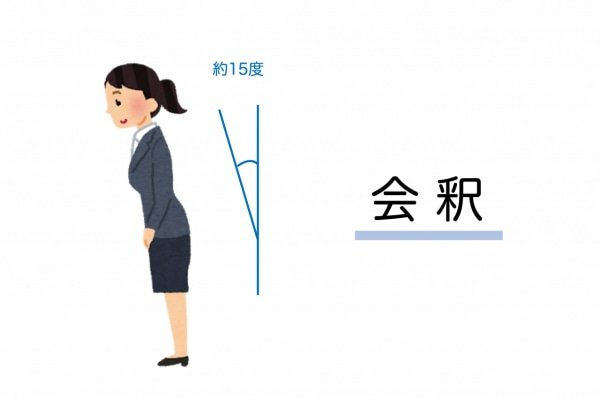
The Eshaku bow(会釈)
This is the bow used with people close to you, of the same age, the same class and social standing; it conveys familiarity and lightness. For this bow you only need to bend about 15 degrees for 1 to 2 seconds. Eshaku is also the simplest bow and the one Japanese people use most during the day. In office culture, you can use this bow when you meet a colleague for the first time that day; on later meetings the same day you need only smile and nod to them.
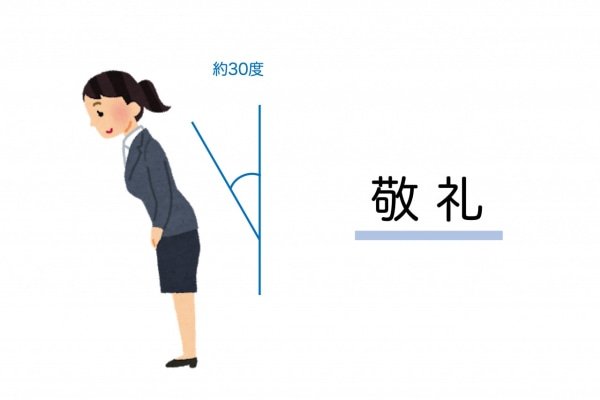
The Keirei bow(敬礼)
Keirei is more formal than Eshaku. This is the bow for greeting a superior, an older person, a customer, or a partner you are signing a contract or doing business with,… For this bow you bend 30 to 35 degrees for 2 to 3 seconds. If you are sitting on the floor and want to make this bow, both hands must be placed face down on the floor 10 to 20cm apart, and then you bow (keeping your head about 10 to 15cm from the floor).
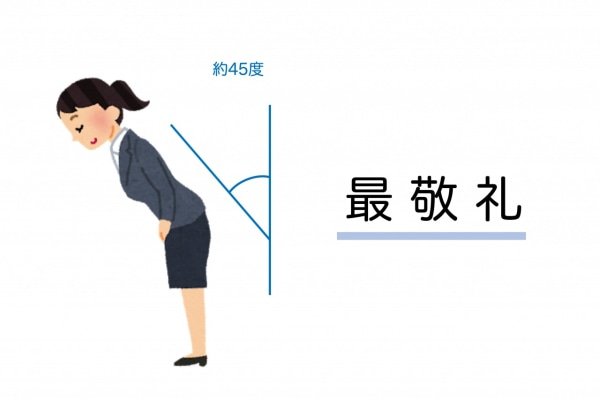
The Saikeirei bow(最敬礼)
This bow shows the highest respect for the other person. For it, Japanese people usually bend low at 45 to 60 degrees and hold for about 3 seconds, or even longer. Japanese people use the Saikeirei bow to show gratitude and reverence to the highest and most sacred beings such as gods, the Buddha or God,… or to especially important people such as grandparents and parents,… This bow is also used to show sincere remorse when apologising to someone for a mistake you have made.
ST.
See also:
Basic Japanese Conversation Sentences
200 Common Japanese Conversation Sentences