The Obon Festival in Japan
Translated from the Vietnamese original. View the original.
The Obon festival has a meaning similar to Vietnam's Wandering Souls Day (Xá tội vong nhân) on the full moon of the seventh lunar month.
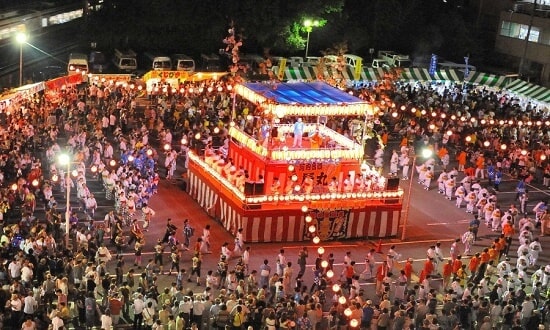
Japan's Obon festival is held at 3 different times depending on the region:
July Bon (Shichigatsu Bon): 15 July (solar calendar)
Old Bon (Kyu Bon): 15th day of the 7th lunar month
August Bon (Hachigatsu Bon): 15 August (solar calendar)
Of these, Hachigatsu Bon is the largest and is held in Kyoto, attracting large numbers of residents and tourists.
Before the festival, around the 13th, people hang lanterns in front of their houses and along the paths leading to them to welcome and guide the spirits of the departed back to their old homes.
On the same day, people carry out activities similar to the Vietnamese custom of tending graves: visiting graves, cleaning and repairing tombs, and making offerings to invite deceased relatives to come home. The offerings include characteristic sweets and beautifully arranged fruit, and are changed each day of the festival so the spirits feel happy and always welcome.
Tourists and international students in Japan should not miss the chance to enjoy the Odori dance and admire the Fire Offering Ceremony, the two most distinctive features of Obon.
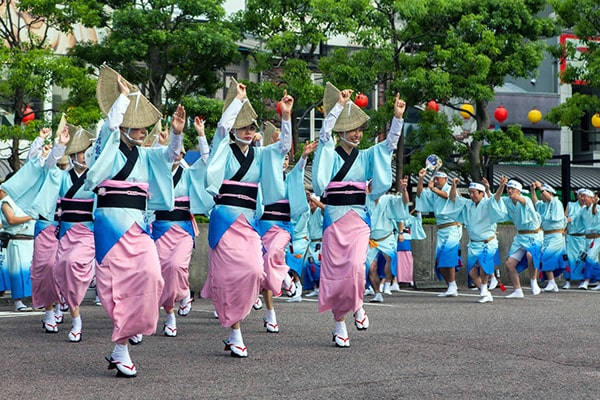
This is a festival popular throughout Japan, with a sacred and slightly mysterious atmosphere. Every August, Japanese families gather during a fairly long holiday; children living far away return to visit their parents and grandparents and visit the family graves together. Obon is the time when the spirits of the departed return to the world of the living. Whereas in Vietnam we burn votive paper and offer sweets, during Obon Japanese families offer rice-flour sweets and beautiful baskets of fruit.
The largest Obon festival is held in the ancient capital Kyoto, where the highlight is the Fire Offering Ceremony that lights the way for the spirits to return to the heavens, a ritual said to date back to the Muromachi period (1336-1573). It attracts many residents and tourists from all over the world.
In this sacred fire ceremony, 5 huge bonfires are lit one after another on 5 mountains around Kyoto over about an hour, creating one of the most spectacular sights of a summer night in Japan's ancient capital.
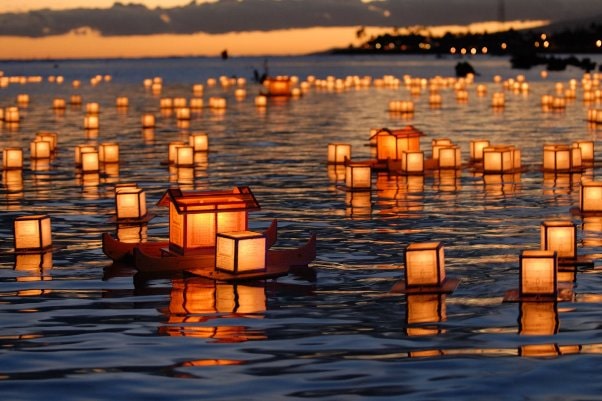
During the Fire Offering Ceremony, the 5 characters 大 (Dai), 妙 (Myō), 法 (Hō), the boat shape and a smaller 大 are lit in turn on 5 mountains around Kyoto; each glows for nearly 30 minutes, creating a sacred, warm and majestic scene. The Japanese believe the light guides the spirits back to the heavens peacefully.