Telling ~たら and ~と Apart
Translated from the Vietnamese original. View the original.
THE DIFFERENCE BETWEEN ~たら AND ~と
Both TARA and TO indicate a condition. When something will happen under a certain condition, you use TARA or TO to express that condition.
But compared with TARA, the use of TO is more limited. TO is used when you want to say that under a certain condition something always happens, as a rule, a habit or a known outcome.
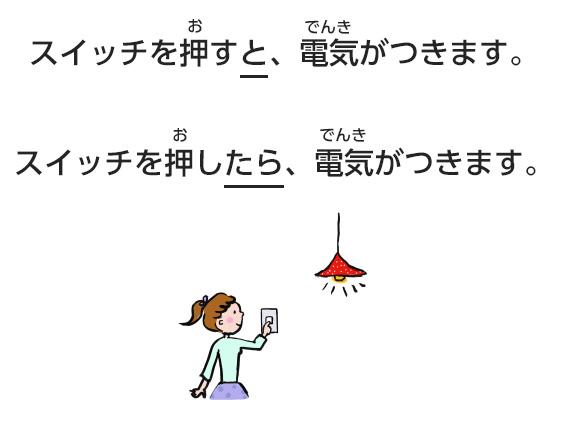
Take the sentence: "if you flip the switch the light comes on". Here TO joins the condition part, "flip the switch", OSHIMASU, with the result part, "the light comes on", TSUKIMASU. So you say OSU TO TSUKIMASU. In this case you can also use TARA and say OSHITARA TSUKIMASU.
However, you cannot use TO if after the condition you want to express your own intention. TARA is used if after the condition you invite someone to do something with you, or make a suggestion or express a hope. So you have to use TARA in the sentence AME GA FUTTARA, KAERI MASHÔ, "If it rains, let's go home".

TARA can be used in a wider range of cases than TO. So when you aren't sure which one fits better, the safest choice is TARA.