Advice for Anyone Hoping to Go to Japan (as a Technical Intern)
Translated from the Vietnamese original. View the original.
Advice for anyone hoping to go to Japan (as a technical intern)
I am writing this to let off some of the frustration I feel with my students, the technical interns working at my company.
I tell them to study Japanese and they answer: ”Why do you keep making us study Japanese when we are already worn out from work? And not everyone has the head for learning Japanese!”
In truth I am not making them study Japanese – the intern programme has plainly changed at a fundamental level.
The change comes from Japan's creation of the Tokutei visa.
The Japanese side has prepared for this. Jitco was, after all, a Japanese state organisation (under important ministries). Running the trainee programme, now called the technical intern programme, cost it a great deal of its standing. The Japanese government was criticised for running an intern programme which, as the name and its nature suggest, was meant to transfer Japanese technology and advanced techniques and to train quality human resources in support of developing countries. Japan ran the programme very seriously at first. But it did not match reality or Japan's own needs.
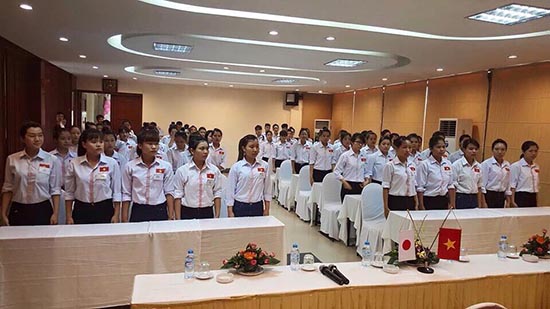
That is, a true trainee should be someone already working at a company, sent to Japan to train and gain practical experience, and then returning to their old company in Vietnam.
And in reality? In reality most small and medium-sized Japanese companies simply need plain labour. Nor can they spend money going to Vietnam to find exactly the industry they want and a Vietnamese person already working in it, bring them to Japan to work and train, and then send that person back to Vietnam. So from the very start there was a wide gap between the meaning and the name of Japan's intern programme and what actually happened.
There was only one big point in common: the Japanese side needed plain labour and the Vietnamese side (the workers) wanted to go to Japan to earn money.
The upshot was that the Japanese side knew perfectly well what was going on and accepted it anyway. In practice, though, the paperwork and the procedures had to be followed. So the Vietnamese side (the dispatching company) always put together a file that was “not true to the facts”. The worker plainly was not employed at company A, B or C – but the file had to say so for the procedure to be correct.
Because of this procedure, which at first no one dared be too open about, there was also the rule that, in principle, anyone with a university degree could not be accepted onto the intern programme. You had to declare, as the procedure required, that you were working at some company or other.
Later Japan allowed degrees to be declared. And more than a few people came to grief over this (unable to return to Japan on a work visa, and unable to explain themselves either).
—
Because Jitco had attracted so much bad press, the Japanese government decided to rename it OTIT, and when the Senmonkyu exam appeared (taken by interns before they leave Japan) the running of the exam was handed over entirely to the industry associations.
So in the old days Jitco managed and ran the exam – playing the match, blowing the whistle and chairing the organising committee all at once – and passing was a foregone conclusion. A high failure rate would have damaged the standing of the intern programme itself, and Jitco with it. Which is why interns kept telling each other they would pass whatever happened (assuming the host company would do whatever it took to get them through).
Today, for the first exam (within a year of the intern arriving in Japan), the pass rate is still close to 100%, although it has become much harder.
But the Senmonkyu exam has been handed to the associations, and they fail people without hesitation. Every resit brings them more money. The fee has risen sharply too. I don't know about other industries, but in food processing it is 27,000 yen per person per sitting. And although it is still far easier than the Tokutei exam the associations run for open candidates, you will certainly fail it if you don't study properly.
I often tell my students that they are throwing away 100 man if they cannot pass the Senmon exam (think how many people in Vietnam want to sit it and cannot). And for the sake of your own future, try hard enough to carry that certificate home to Vietnam – the Japanese proficiency exam is held regularly in Vietnam, but at present the Senmon exam can only be taken in Japan. And it really is quite hard, because the examiners speak Japanese too. So you have to study.
And yet my students say “Why should we have to study for the company's sake?!”
I explained very clearly that it has nothing to do with the company. If anything, it earns the title 優良企業(ゆうりょうきぎょう), an outstanding company. And even that is out of reach, because someone at my company (a friend) has already failed. Besides, the company used to care about the title because it allowed good interns to come back. But now that the Tokutei visa exists, there is no need to come back for another 2 years – you move straight onto Tokutei.
I have gone on far too long, but my point is this: if you cannot learn Japanese and you don't like Japan, then don't come to Japan.
As I said, Japan is Heaven if you go as a tourist and Hell if you go to work.
You need to be ready for that. And going to Japan as a technical intern is not really about earning money – it is about changing your life.
Because the money only goes so far; there is no more working unlimited overtime. Earning a lot now probably means breaking the law: selling dodgy or counterfeit goods, or defrauding other Vietnamese.
And what does “changing your life” mean? It means a trade-off for a better future. Or it means a bad ending: becoming a criminal, falling ill, even losing your life.
All of it depends on …you, and on how you think.
(Remember…everything carries luck and risk…even staying in Vietnam)
—
Source: Pham Quyen fb.com/quyenjp
See also:
A Few Words for Technical Interns in Japan
Important Things to Know About Living in Japan