Respectful Language in Japanese
Translated from the Vietnamese original. View the original.
Respectful language in Japanese
We hope this material helps you study and revise for the JLPT as well as possible.
RESPECTFUL LANGUAGE AND HUMBLE LANGUAGE
One of the harder items in the JLPT at every level; and even when you speak fluently, outside a business setting we have little chance to use it, so when we are asked about it ….
Let us hope this summary table earns you a few more marks in the grammar section.
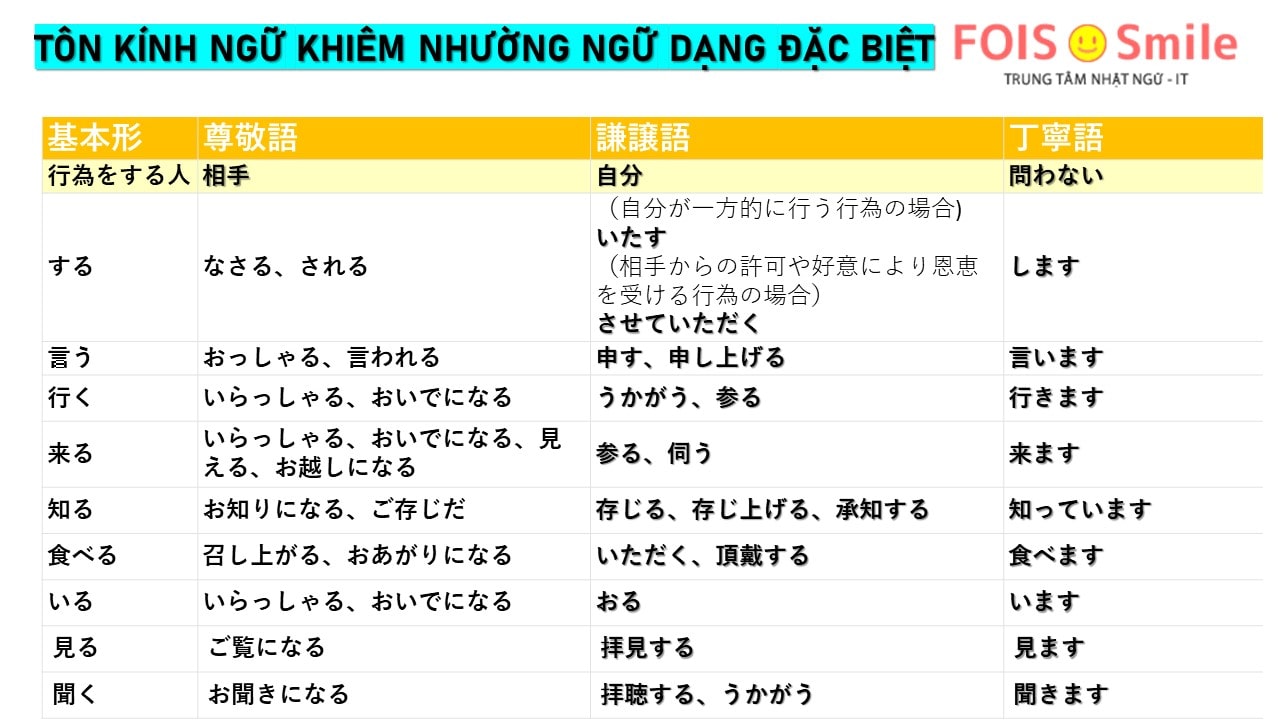
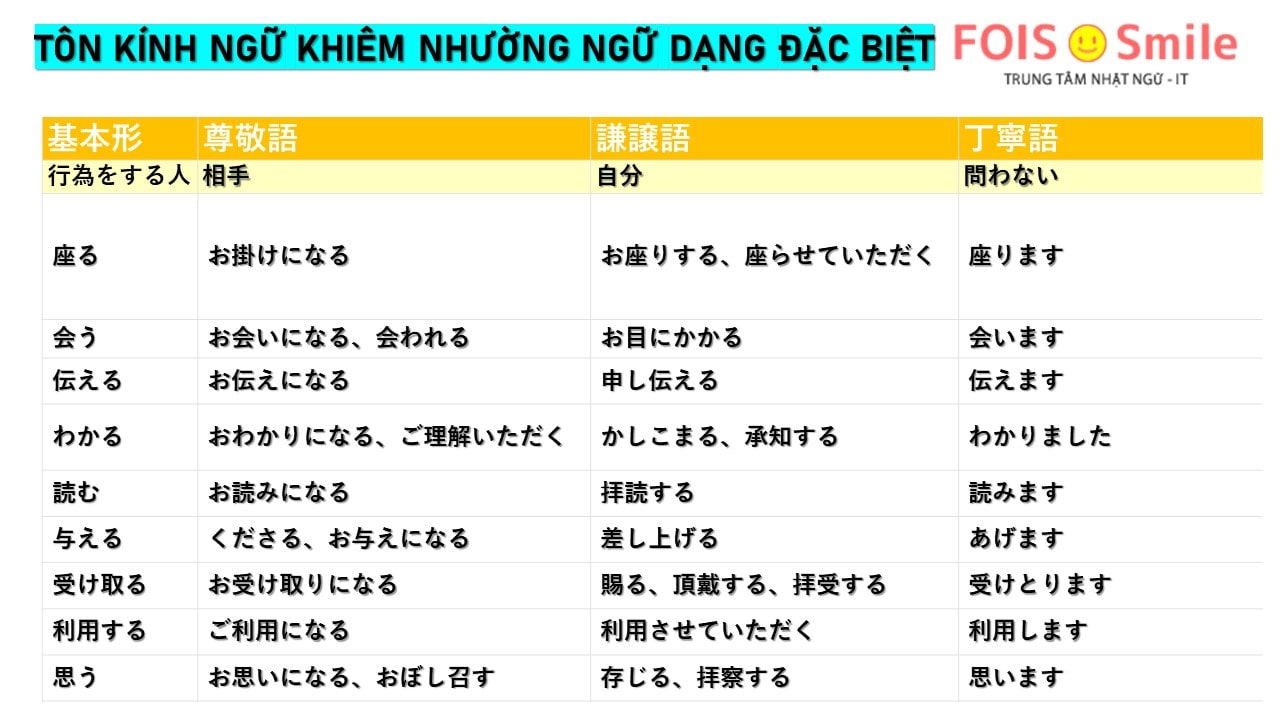
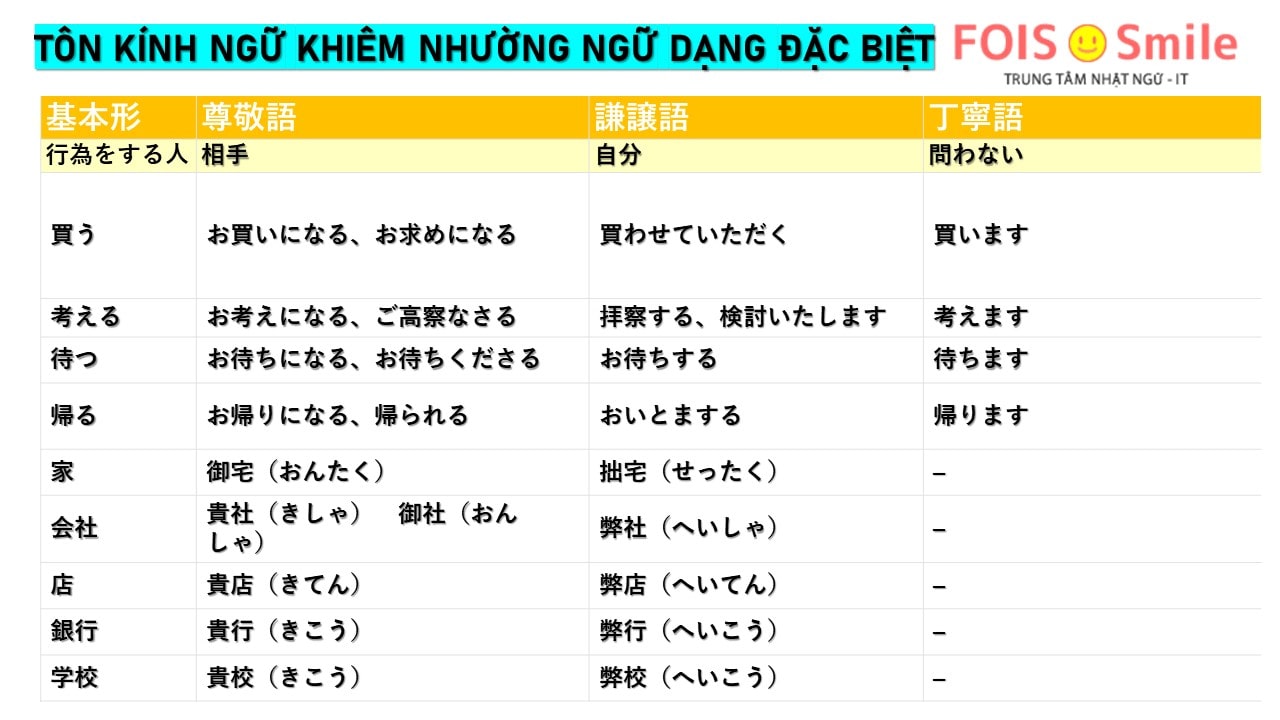
Respectful language in Japanese
As well as being famous for their discipline and bearing at work, Japanese people are known for their politeness in conversation. Honorific language is the expression of that quality. Here is a brief outline of honorific language in Japanese.
1. Where is honorific language used? When?
*You arrive in Japan and go to a phone shop meaning to buy a smart mobile phone. The assistant says to you:
どうぞ おかけくさい
Does this mean the shop assistant is inviting you to make a call (since you have learnt that かける means to make a phone call)? Not at all. It is a polite invitation to sit down in Japanese.
*You go shopping at a supermarket and the sales assistant says to you:
1000円 お預かりします
This too is a humble form of the word あずかります, meaning to receive or to take something for the time being.
*You visit a friend's house and your friend's mother asks you:
東京へいらっしゃったこと、おありですか?
This too is an expression of honorific language.
From the examples above you probably now have some idea of honorific language in Japanese.
For those new to Japanese, “Honorific language (Keigo)” is probably the section you care least about, but in fact it is the hardest body of knowledge. In business dealings, honorific language comes first.
What is more, Japanese people judge your level not by how fluently you speak but by how you use honorific language in Japanese. I dare not go into this any more deeply, but let me set down a few basic points, and I hope those with more experience will add to them.

2. The rules and the kinds of honorific language
Honorific language is used towards people above you, or people you are not close to, and usually in formal situations. Especially in business dealings and trade. There are 3 kinds of honorific language: respectful language, humble language and polite language.
尊敬語 (そんけいご) (respectful language):
謙譲語 (けんじょうご) (humble language):
ご丁寧語 (ていねいご) (polite language):
These are words used to show respect for the other person's state, actions, qualities and so on.
Attach the prefix 接頭辞 (せっとうじ) : 「お」 or 「ご」
Example: お手紙 : a letter ご意見 : an opinion
Attach 「れる」 「られる」 to the other person's action. The verb is put into the short negative form (the ない form) and then ない is dropped.
Example: 行かない >>> 行か 来ない >>> 来
Then combine it as follows:
行かれる 来られる
● Attach お・ご+<連用形 (れんようけい)>+になる
The verb is put into the stem form (連用形). That is, the verb is put into the 「ます」 form and then 「ます」 is dropped.
Example: 帰ります >>> 帰り 売ります >>> 売り
Then combine it as follows:
Example: お帰りになる ご覧になる
社長はもうお帰りになりました。(The director has gone home)
These are words used to lower yourself, or to be modest about what belongs to you.
● Attach お・ご+<れんようけい連用形>+する
お帰りする ご案内する
Example: * Compare the following 2 sentences:
– この問題について案内します。(I will explain this matter to you).
– この問題についてご案内します。(Allow me to explain this matter to you)
We can see that the meaning of the two sentences does not change, but in character they are plainly different.
● Attaching 「いたす」「させていただく」 is more polite and more courteous still than the pattern above.
Example: 紹介させていただきます。
おか書きいたします。
It expresses a polite way of speaking to people who are neither above nor below you, or to people you have only just met.
● Use the forms 「です」 「ます」 「ございます」
* Besides the rules above, there are also some words we might call irregular (like the irregular verbs in English). Do look at the table of irregular words. Since they follow no rule at all, there is nothing for it but to learn them by heart.
For those new to Japanese, “Honorific language (Keigo)” is probably the section you care least about, but in fact it is the hardest body of knowledge. In business dealings, honorific language comes first.
What is more, Japanese people judge your level not by how fluently you speak but by how you use honorific language in Japanese. I dare not go into this any more deeply, but let me set down a few basic points, and I hope those with more experience will add to them.
See also:
The Honorific Way of Saying 大丈夫 in Japanese
Honorific Language in Japanese – How to Use It