N5 Japanese Books
Translated from the Vietnamese original. View the original.
To learn Japanese well and get a firm grip on the basics you have to pick the right standard course books so you can cover every skill. Some people buying N5 Japanese books buy only the two main volumes, the textbook and the vocabulary and grammar explanation book. If you buy only those two you will be missing many other skills: kanji, reading and listening.
To choose a complete set of Japanese books for beginners, have a look at the article below.
Which books make up the N5 set:
First you should study the Minna no Nihongo course to build a really solid foundation. The Minna no Nihongo set is made up of several different books. You should study all of the books in the set:
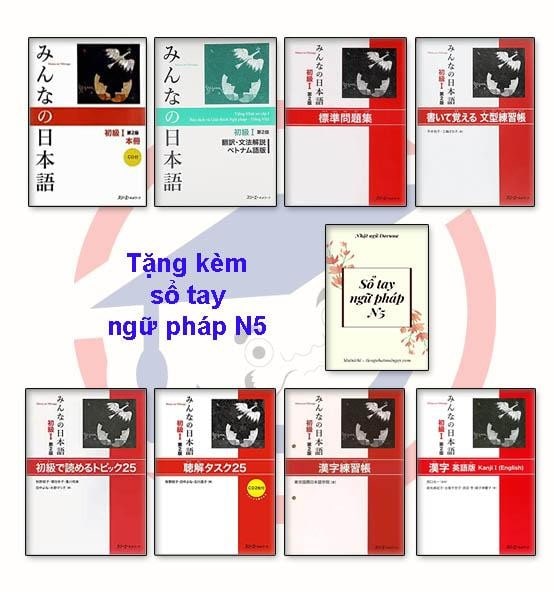
The textbook: this is the book where you practise again the grammar patterns you learned in the vocabulary and grammar explanation book.
The vocabulary and grammar explanation book: it supplies the vocabulary for each lesson, from beginner level upwards, and explains the beginner grammar for N5 level. These are the two most basic N5 Japanese books.
The Choukai Tasuku book: you can practise listening in the textbook, but the listening passages there are not enough, so you have to practise more with Choukai Tasuku to raise your Japanese listening level. Many people take listening lightly and then struggle badly at higher levels.
The Topikku book: it has many reading passages that help you practise reading Japanese and build up more advanced vocabulary. This book lets you practise sentence structures again and revise vocabulary.
The Hyoujun Mondai workbook: this book helps you drill sentence structures and Japanese particles until they are solid. With plenty of particle exercises and other drills, it makes your Japanese grammar much surer.
See other N5 course books: n5 japanese books
Once you have finished the Minna no Nihongo course you can look at other N5 books to revise before sitting the N5 exam, such as:
Try N5
Try N5 will give you a solid grounding in grammar, with simple explanations that make self-study easy.
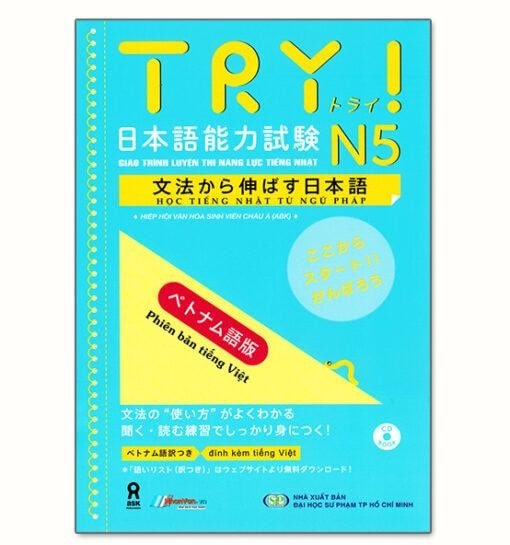
Highlights:
Every grammar pattern in the book comes with several concrete examples, so learners not only grasp the grammar but also understand the context it is used in, and so arrive at the most natural Japanese expression possible.
After each grammar pattern there are exercises so you can practise it straight away. You learn from experience and pick up how to apply the pattern through each specific exercise. The book also has star-ordering exercises so you can practise sentence ordering and apply it in the exam itself.
At the end of the book there is a summary table of the grammar patterns in alphabetical order, helping you organise what you have learned and look things up easily when you need to.
Tango N5
This is the N5 Japanese book that builds up your vocabulary.
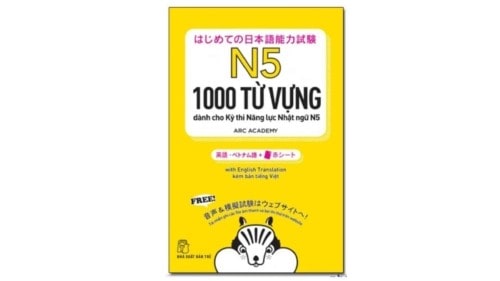
Highlights:
The book has 1000 basic words; on top of that it gives "synonyms", "antonyms" and "related and equivalent words", coming to around 2000 words in total.
All the kanji have readings given. So you can study without needing a dictionary.
The book is printed in red and comes with a red sheet, which makes revision effective: cover the page with the red sheet and the red text disappears.
The vocabulary in the book is both close to the JLPT exam and suitable for everyday situations, such as: introducing yourself, study, work, friends, eating and drinking, hobbies, shopping, days off,…
Zettai Goukaku N5
Once you have built up all the knowledge you need, this is the right moment to try yourself against mock papers. The Zettai Goukaku N5 course book helps you revise and at the same time see your current ability, so you are ready for the real exam.
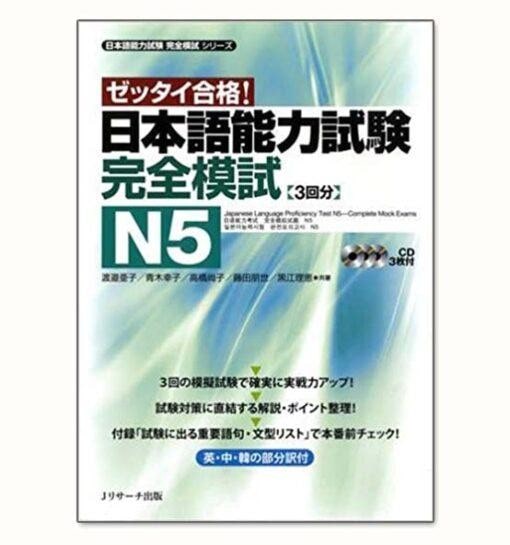
Highlights:
The book has 3 mock papers with the same structure and difficulty as the real exam. This is how learners can measure their level accurately. You test your level by sitting the paper against the clock as in the real exam, then check how many you got right and learn from it.
At the end of the book there are answers with detailed explanations, plus extra new vocabulary and a grammar summary, making self-study easier.
The book also lists many words that come up often in JLPT papers, so learners can prepare as well as possible for the real exam.