Learn Minna no Nihongo Grammar – Lesson 49
Translated from the Vietnamese original. View the original.
Learn Minna no Nihongo Grammar – Lesson 49
Let’s study N5-level Japanese grammar, lesson by lesson, following the Minna no Nihongo textbook.
Minna no Nihongo lesson 49 mainly covers honorific language in Japanese
Japanese honorific language is 尊敬語(そんけいご)
Honorific language is used when a junior speaks to a senior, for example an employee to the company president, or a student to a teacher,..
Honorific language is not used within the family
How honorific words are formed
1) Using the prefixes 「お」 and「ご」 (both written with the kanji 御)
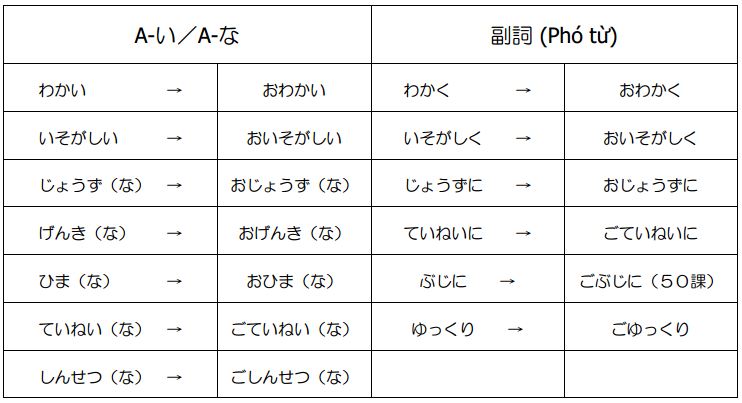
The prefixes 「お」 and「ご」 are used a great deal in honorific sentences. As a prefix, 御 is added in front of various word types (nouns, adjectives, adverbs) and has 2 readings, sometimes 「お」 and sometimes「ご」, depending on whether the word it attaches to is a native Japanese word (和語) or a Sino-Japanese word (漢語).
Native Japanese words are words of Japanese origin that the language has had since ancient times, while Sino-Japanese words came from China. (As a rule of thumb, native words are written with one kanji, Sino-Japanese words with two)

In principle, 「お」 goes with native Japanese words and「ご」 with Sino-Japanese words.
However, in everyday Japanese there are Sino-Japanese words that still take the prefix 「お」 .
For example: お洗濯する、お掃除する、お邪魔する.
Other examples:
Nouns: お宅、お国、お子さん、ご家族、ご質問、ご気分
Adjectives: お忙しい、お元気、お上手
Adverbs: ごゆっくり、ごいっしょに、お大事に
2) Using the passive form to make honorific words
V(ら) れます.
◈ Meaning: expressing respect
◈ Usage: In form, honorific verbs of this type conjugate exactly like the passive. Almost all verbs can be used this way except potential verbs (可能形) and a few verbs such as: できます、わかります、いります
Both men and women use it, but men use it more. It is also often used in writing.
◈ Examples :
社長は さっき 出おかけられました。 The company president went out a moment ago.
お酒をやめられたんですか。 Have you given up drinking?
いつ ベトナムに来られましたか。 When did you come to Vietnam?
会長は 今アメリカへ 出 張されています。 The chairman is on a business trip to America
* Note: Honorific language is not used about the speaker’s own actions, so when answering a question asked in honorific language you do not use honorific forms for your own actions.
3) Turning the -MASU form into honorific language
おVます になります
◈ Meaning: expressing respect (the highest level)
◈ Usage: – This is a very flexible expression, more respectful than using the passive form. Both men and women use it, but women use it more.
– It does not apply to group 3 verbs or one-syllable verbs such as: 見ます、 寝ます、います…
社長は お帰りに なりました。 The company president has gone home.
新聞を お読みに なりますか。 Do you read the newspaper?
部長は 加藤さんを お呼びに なりました。 The department manager called Ms Kato
* Note: Honorific language is not used about the speaker’s own actions, so when answering a question asked in honorific language you do not use honorific forms for your own actions.
A: 今晩何時に 山本さんに お会いに なりますか。 What time are you meeting Ms Yamamoto this evening?
B: 6時15分過ぎに 会います。 I am meeting her just after 6:15
( 6時15分過ぎに お会いになります。(×) )
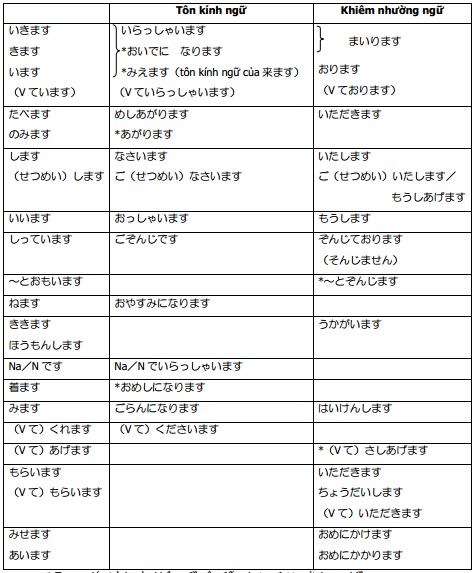
4) Honorific words that do not follow the rules above
these special cases have to be memorised
5) Honorific forms of nouns
At the level of individual nouns, besides the special honorific words listed above, the prefixes「お」 and「ご」 can be used to make honorific forms. However, some nouns cannot take 「お」 or「ご」 .For example: ×お会社
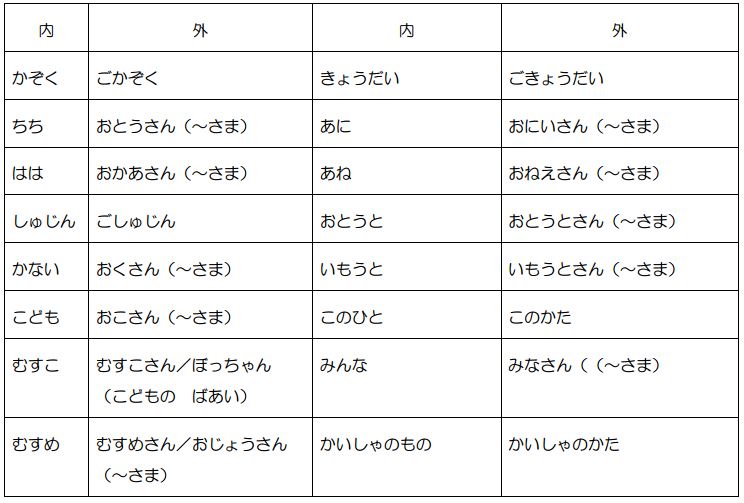
Explanation:
1. Some nouns for positions such as 部長、先生、社長…already carry respect in themselves, so「さん」 is not needed ×先生さん
2. With nouns that do not already carry respect, 「さん(さま)」 can be added to make them more polite
客→お客さん(さま) 二人→お二人さん(さま)
医者→お医者さん(さま) 花屋→(お)花屋さん
3. A point that needs particular care is talking about a senior from your own in-group to someone from outside it.
If you only consider the senior–junior relationship it is fairly easy, since you just use honorific words for the senior; but taking the in-group/out-group relationship into account as well makes it harder.
For example, when person A talks to person B about person C, a senior in A’s in-group, it works like this:
(1) When B (the company president) is an outsider:
○ A:(わたしの)父は 明日 大阪へ 行きます/参ります(lesson 50)
× A:(わたしの)お父さんは 明日 大阪へ いらっしゃいます。
(2) When B (A’s older brother) is an insider:
○ A:お父さんは 明日 大阪へ いらっしゃる/行く。(行きます。)
× A:父は 明日 大阪へ 行きます/参ります。 (lesson 50)
6) Honorific forms of adjectives
As with nouns, the prefixes 「お」 and「ご」 can be added to make honorific forms. However,
there are cases where they cannot be used. E.g.: ×おいい ×おおいしい