Learn Minna no Nihongo Grammar – Lesson 48
Translated from the Vietnamese original. View the original.
Learn Minna no Nihongo Grammar – Lesson 48
Let’s study N5-level Japanese grammar, lesson by lesson, following the Minna no Nihongo textbook.
I. How to make the causative form (from the dictionary form):
Group I: change the ending 「u」to a +せる
| Dictionary form | Causative form |
| 書く(かく) | 書かせる |
| 急ぐ(いそぐ) | 急がせる |
| 飲む(のむ) | 飲ませる |
| 呼ぶ(よぶ) | 呼ばせる |
| 作る(つくる) | 作らせる |
| 手伝う(てつだう) | 手伝わせる |
| 持つ(もつ) | 持たせる |
| 直す(なおす) | 直させる |
Group II: drop る and add させる
| Dictionary form | Causative form |
| 食べる(たべる) | 食べさせる |
| 調べる(しらべる) | 調べさせる |
| 覚える(おぼえる) | おぼえさせる |
Group III
| Dictionary form | Causative form |
| する | させる |
| 来る(くる) | 来させる(こさせる) |
II. How it is used and its patterns:
1. The causative form expresses permission (letting someone do something) or an order, request or compulsion (making someone do something). Because it expresses a strong order from a senior to a junior, who then has to comply, it is not used between equals or towards superiors; instead the giving-and-receiving patterns already learned are used, such as: 「Vていただく(lesson 41)」、「Vてもらう(lesson 24)」(however, verbs expressing feelings such as 「しんぱいする、びっくりする、困る」can still be used with superiors, meaning to make someone worry, to surprise someone, to cause someone trouble…)
2. Patterns:
2.1. Case #1: with intransitive verbs (自動詞)
Structure : ~を V(さ)せる
Meaning: To let (someone) do ~; to make (someone) do ~
Usage: An intransitive verb is changed into the 「使役(しえき)」 form to make a new verb meaning to order or ask someone to do something. In this lesson the main intransitive verbs used are: 行く、来る、帰る、通う、 出 張する、 出席する、遊ぶ. In this kind of sentence, the person performing the action takes the particle 「を」。
– This kind of sentence is also called a 「を-使役文」(a causative sentence with を)
Examples:
(1)部長は 加藤さんを 大阪へ 出 張させます。
The department manager sent Mr Kato on a business trip to Osaka.
(The department manager is the subject of the sentence, but the person who goes to Osaka is Mr Kato)
(2) 私は 娘を 自由に 遊ばせました。
I let my daughter play freely.
(I am the subject of the sentence, but the one who plays is my daughter)
2.2. Case #2: with transitive verbs (他動詞)
Structure: ~に ~を V(さ)せる
Meaning: to let (someone) do ~; to make (someone) do ~
Usage: a transitive verb is changed into the 「使役(しえき)」 form to make a new verb meaning to order or ask someone to do something. In this kind of sentence the person performing the action takes the particle 「に」, while the object of the verb is still marked by 「を」.
– This kind of sentence is also called a 「に-使役文」(a causative sentence with に)
Examples:
(5)先生は 生徒に まどを 開けさせました。
The teacher had the students open the windows.
(6) 朝は 忙しいですから、 娘に 朝ごはんの 準備を 手伝
Mornings are busy, so I get my daughter to help prepare breakfast.
Further reading:
1) When the doer of a transitive verb takes + 「を」
Some special cases use both「を」and「に」
Verbs such as 「待つ、勉強する」are transitive but can sometimes take the particle 「を」
わたしは 弟を 駅で 待たせた。
わたしは 弟に 父の帰りを 待たせた。
わたしは 娘を アメリカで 勉強させた。
わたしは 娘に ピアノを 勉強させた。
2) When the doer of an intransitive verb takes + 「に」
a. Case 1:
Verbs such as「行く、来る、帰る、歩く」 are intransitive but sometimes take the particle
「に」 to avoid repeating the particle 「を」
先生は 学生を 歩かせた。
先生は 学生に 山道を 歩かせた。
b. Case 2:
Verbs such as「答える、しゃべる、言う、質問する、反対する、発言する」 are intransitive verbs whose action is directed at someone, and they often take 「に」 instead of「を」
・彼に 答えさせた。
・山田くんに 言わせよう。
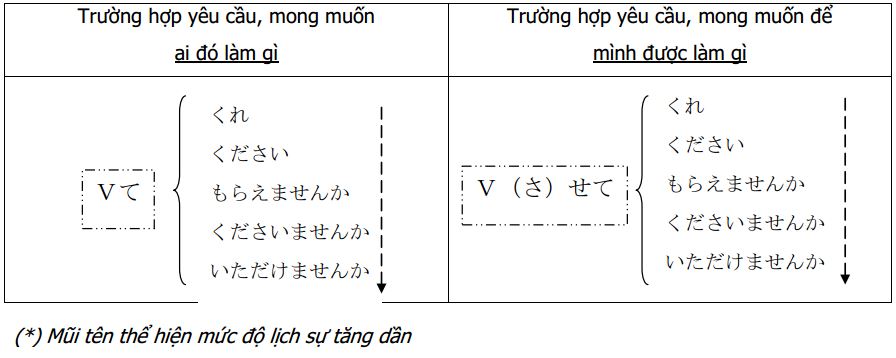
C . The pattern させていただけませんか (a polite way of asking permission)
Meaning: would you allow me to (do something)?
Usage: Used to ask permission, to request that the listener confirm and allow you to do something
Examples:
すみませんが、 早く 帰らせて いただけませんか。
Excuse me, would you allow me to leave early?
コピー機を 使わせて いただけませんか。
Would you allow me to use the photocopier?
すみませんが、 写真を 撮わせて いただけませんか。
Excuse me, would you allow me to take a photo?
Extension:
・Besides the expression above, the following can also be used to ask permission
「V(さ)せて ください」
「V(さ)せて くださいませんか」
・Note who performs the action in these 2 request patterns: