Learn Minna no Nihongo Grammar – Lesson 43
Translated from the Vietnamese original. View the original.
Learn Minna no Nihongo Grammar – Lesson 43
Let’s study N5-level Japanese grammar, lesson by lesson, following the Minna no Nihongo textbook.
1. Grammar
V そうです
(Guessing about the state just before a change happens)
Meaning: about to
Usage: used to describe a state or condition you can see from outside, to give an impression from something you have seen with your own eyes, or to explain the state of something just before it changes.
How it is formed:
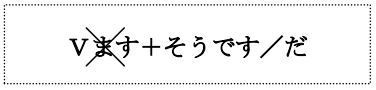
Examples:
曇っていますね。 雨が 降りそうです。
The sky is very cloudy. It is about to rain.
もうすぐ 桜が 咲きそうです。
The cherry blossoms are about to bloom.
これから 寒くなりそうです。
It is about to get cold.
今にも 荷物が 落ちそうです。
The luggage is about to fall.
煙が 少なくなりました。 火事は 消えそうです。
There is less smoke now. The fire is about to go out.
2. The grammar pattern A/Naそうです
Meaning: looks like
Usage: used to express a direct judgement or impression on seeing something. Roughly, this pattern means “looking at it, I think it is like that”.
How it is formed:
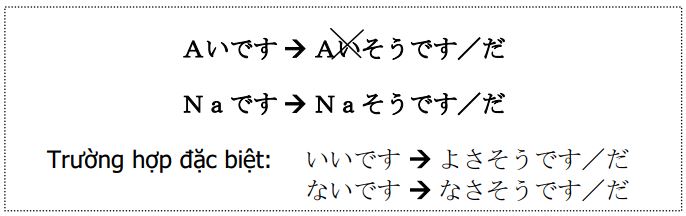
Examples:
この 料理は おいしそうです。
This dish looks tasty.
彼女は 忙しそうです。
She looks busy.
彼は 暇そうです。
He looks free.
あのケーキは おいしくなさそうです。
That cake does not look nice.
「Note」:
・Do not use this expression with adjectives describing something obvious that you can see straight away, such as: 「赤い、きれい、有名、かわいい」
× このりんごは 赤そうです。
This apple looks red. (wrong, because its redness is plain to see)
○ このすいかは 中が 赤そうです。
This watermelon looks red inside.
(correct, because you cannot tell from outside; it is a guess)
・With adjectives expressing a person’s feelings or sensations such as「うれしい、さびしい、かなしい、 いたい、気分が悪い、気分がいい」, since we cannot describe someone else’s feelings directly but only guess at them, we must use「~そうです」
Examples: With the emotion adjective 「うれしい」(happy)
○ わたしは うれしいです。 × わたしは うれしそうです。
○ あなたは うれしいそうです × あなたは うれしいです。
○ かのじょは うれしそうです。 × かのじょは うれしいです。
・This 「~そうです」pattern does not combine with nouns
Further reading:
The difference between 「~でしょう」and「 ~そうです」:
「~でしょう」expresses the speaker’s inference based on some information, while
「~そうです」 expresses the speaker’s inference based on what they observe.
今晩雨が 降るでしょう。 It will probably rain tonight.
(the speaker may have heard it on the radio or read it in the paper)
今晩雨が 降りそうです。 It looks like it will rain tonight.
(the speaker sees the sky is overcast and says so)
3. The grammar pattern V て来ます (Saying you go somewhere, do something and come back)
Meaning: to go and do something (and come back)
Usage: expresses going somewhere, doing something and then coming back. Note that this single pattern covers 3 actions
(1) go somewhere → (2) do something → (3) come back
Examples:
ちょっと たばこを 買って来ます。 I am just going to buy some cigarettes (and come back).
The example above implies 3 actions:
(1) going to where cigarettes are sold → (2) buying cigarettes there, and → (3) coming back.
ちょっと 電話を かけて来ますから、ここで 待っていて ください。
I am just going to make a phone call, so please wait for me here
教 室に 時計を 忘れたので、ちょっと 取って来ます。
I left my watch in the classroom, so I am going to fetch it.
Note:: The place you go to and do the action is marked by the particle 「で」. However, when the place is where you take something from (or move it from), the particle 「から」 is used.
スーパーで 牛 乳を 買って来ます。
I am going to the supermarket to buy milk.
台 所から コップを 取って来ます。
I am going to fetch a cup from the kitchen.
Comparison:
The difference between 「(place)へVに行く」 and 「(place)でVて来る」
| あの店へ 買いに 行きます。 | あの店で 買って来ます。 |
| 1 あの店へ 行く | 1 あの店へ 行く |
| 2 あの店で 買う。 | 2 あの店で 買う |
| Covers only 2 actions | 3 あの店から 来る |
| Covers 3 actions |