Learn Minna no Nihongo Grammar – Lesson 42
Translated from the Vietnamese original. View the original.
Learn Minna no Nihongo Grammar – Lesson 42
Let’s study N5-level Japanese grammar, lesson by lesson, following the Minna no Nihongo textbook.
1. The grammar pattern ~ために (expressing purpose)
Meaning: In order to
Usage: This pattern expresses purpose. The clause before ために states the purpose, and the following clause states the deliberate action taken to achieve it.
There are 2 ways to use it: with verbs and with nouns, as follows:
1.1 the pattern V1るために、 V2
(In order to do V1, do V2)
The verb before 「ために」 is in the dictionary form and must be a volitional verb expressing a purpose.
Examples:
らいねん 世界旅行を するために、 今お金を ためています。
I am saving money now so that I can travel next year.
漢字を 勉 強するために、 辞書を 買いました。
I bought a dictionary in order to study kanji
Note:
1/ The difference between「~ように」 (lesson 36) and「~ために」
* What they have in common:
– The first clause is the purpose of the second, and the second is the action taken to achieve it.
– The verb in the first clause is volitional. In the second clause, both volitional and non-volitional verbs can be used.
– Both「~ように」 and「~ために」 take a verb in the dictionary form. (The form 「V ないために」 is not often used)。
* The difference:
In the first clause – the clause expressing purpose – the pattern 「~ように」 can also take a non-volitional verb.
2/ Volitional and non-volitional verbs:
– Volitional verbs express actions that a person can control by their own will.. E.g.: たべる(to eat), のむ (to drink), いく (to go), つくる (to make), ねる (to sleep)….
– Non-volitional verbs express actions or events that a person cannot control, including:
+ The movement or state of inanimate things: ある(to exist), 壊れる (to break), 雨が降る (rain falls), 風が吹く (the wind blows), 水が出る (water flows)…
+ Physical phenomena of the body:痛む(to hurt), 病気になる (to fall ill), 老いる(to grow old) , 若返る(to grow young again), 目が覚める(to wake up)…
+ Mental phenomena : 困る(to be in difficulty) , 飽きる (to grow tired of), できる (to be able to)… and verbs in the potential form.
However, besides the examples above, the same word can be volitional in one context and non-volitional in another.
For example: the verb「出る」 (to come out / to leave)
– 家を出る。 To leave the house ☞ a volitional verb
– 水が出る。 Water comes out ☞ a non-volitional verb
* Further point: In the pattern 「~ために」 , if the first clause has a non-volitional verb or a natural phenomenon, that clause does not express purpose but becomes a clause of cause or reason:
Examples:
毎日雨が降ったために、 橋が 壊れた。
The bridge broke because it rained every day
1.2. The pattern N のために、V
When combined with a noun, the clause 「N のために」has 2 meanings:
① With nouns for events, the clause also expresses purpose (like the verb pattern「V るために」)
健康のために、たばこを やめた。
I gave up smoking for my health.
発表の 準備のために、本を 借りました。
I borrowed books to prepare for my presentation
With nouns for natural disasters… the clause usually expresses a cause or reason
台風のために、木が 倒れた。
The tree fell because of the typhoon.
② With nouns for people… the following clause is an action done for their benefit
家族のために、一生懸命働かなければなりません。
I have to work as hard as I can for my family.
奥さんのために、 新しいバイクを買うつもりです。
I am planning to buy a new motorbike for my wife.
2. The pattern
V るのに 使います / 便利です… (another use of the particle に: expressing purpose)
N に 使います / 必要です…
Meaning: (used) for something / (useful) for something / (needed) for something, similar in sense to the patterns 「とき」(lesson 23) and「場合」(lesson 45)
Usage: The particle「に」also expresses purpose. With a noun use 「Nに」; with a verb, nominalise the verb (「曲 げるのに」)
Note: for group III verbs of the form「Nします」, do not combine them as 「Nするのに」 but attach directly as「Nに」.
E.g.: ・勉強します-> 勉強に
・修理します-> 修理に
In expressing purpose, this pattern is quite like 「(の)ために」but weaker, and the second clause is usually limited to certain stative verbs and adjectives such as:
・「~ に使います」 (how it is used)
・「~ に便利です、 必要です、いいです、役に立ちます…」 (evaluation)
・「~ に(時間、お金)がかかります」 (calculation)…
Examples:
a) (N は) V るのに 使います : Usage:
①このはさみは 紙を 切るのに 使います。 These scissors are used for cutting paper.
②この ミキサーは 何に 使うんですか。 What is this mixer used for?.
…原 料を まぜるのに 使います。 It is used for mixing ingredients.
b) (N は) V るのに 便利です/必要です/いいです/役に立つ : evaluation
この辞書は 漢字を調べるのに 便利です。 This dictionary is handy for looking up kanji.
この本は 日本のことを知るのに 役に立ちます。 This book is useful for learning about Japan.
c) (N は) V るのに(時間、お金)が かかります : calculation
この時計は 直すのに 1週間 かかります。 This watch takes a week to repair.
3. Review
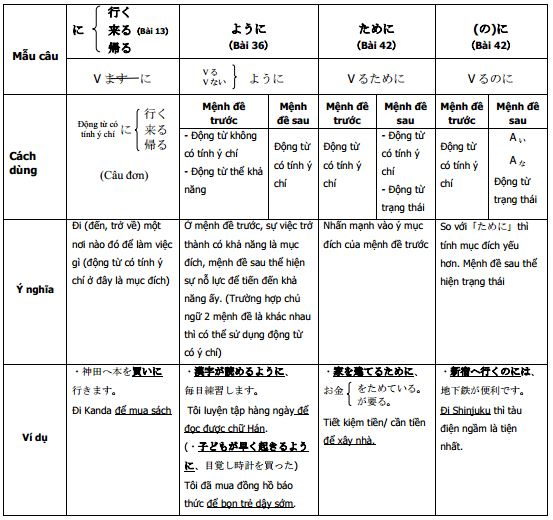
1/ We have met the particle 「に」 expressing purpose in earlier lessons, such as:
① 本を買いに行きます(Lesson 13)
To go and buy a book.
② 体にいい/悪い(Lesson 32)
Good/bad for your health
③ 日本語の新聞が 読めるように、 毎日練習します(Lesson 36)
In this lesson we learn 2 more ways of expressing purpose with 「に」: 「~ために」 and「~(の) に」
2/ Comparing the purpose patterns 「~に」「~ように」「~ために」「~(の) に」