Learn Minna no Nihongo Grammar – Lesson 46
Translated from the Vietnamese original. View the original.
Learn Minna no Nihongo Grammar – Lesson 46
Let’s study N5-level Japanese grammar, lesson by lesson, following the Minna no Nihongo textbook.
1. Grammar with ~ところです (patterns with the phrase ところです)
Earlier, in lesson 8, we learned 「ところ」with the meaning of a place or spot. In this lesson 「ところ」is extended to another meaning: “expressing a point in time” in the pattern
V ところです
Meaning: the point in time shown by 「ところ」changes with the tense of the verb before it. (since 「ところ」is a noun, the verbs combined with it are all in the short form)
There are 3 cases:
1.1. The pattern Vるところです (the action is about to happen)
Meaning: about to (do ~), just going to (do ~)
Usage: Used to say that an action is about to take place, stressing the moment just before it happens. This pattern usually goes with time expressions such as: 「これから、」、 「(ちょうど)今から」
Examples:
(1) A: 昼ご飯は もう 食べましたか。 Have you had lunch?
B: いいえ、これから 食べるところです。 …Not yet, I am just about to eat.
(2) A: 会議は もう 始まりましたか。 Has the meeting started?
B: いいえ、今から 始まるところです。 …Not yet, it is just about to start.
(3) ちょうど 今から お茶を 飲むところです。いっしょに いかがですか。
I was just about to have tea. Will you join me!
1.2. The pattern V ている ところです (the action is in progress)
Meaning: Be in the middle of (doing ~)
Usage: Used to describe an action in progress at a certain moment, stressing that moment (more strongly than V ています). This pattern usually goes with the time adverb 「今」
Examples:
A: ピンポン しませんか。 Do you want to play table tennis?
B: 今 勉強しているところですから、あとで 行きます。
I am in the middle of studying, so I will come later.
A: 会議の資料は もう できましたか。 Are the meeting materials ready?
B: すみません。今 コピーしているところですから、もう少し 待ってください。
Sorry. I am photocopying them right now, so please wait a little longer.
1.3. The pattern V た ところです (the action has just happened, just finished)
Meaning: have just (done ~)
Usage: Used to describe an action that has just finished, stressing the moment right after it is completed. This pattern only goes with the time adverb 「たった今」
Examples:
A: 8時のバスは もう 出ましたか。
Has the 8 o’clock bus gone?
B: はい、たった今 出たところです。
Yes, it has just left.
良子さんは たった今 うちへ 帰ったところです。
Yoshiko has just got home.
A: けさ ハノイに 着いたんですか。
Did you arrive in Hanoi this morning?
B: はい、たった今 着いたところだ。
Yes, I have just arrived.
Note:
– All the ~ところです patterns simply describe a state at a particular moment.
Example: 田中さんは 今 Ha Noi大学 で 働いているところです。
Mr Tanaka is working at Hanoi University right now
(he is at Hanoi University at this moment and is working )
田中さんは Ha Noi大学で 働いています。
Mr Tanaka works at Hanoi University
(he usually works at Hanoi University, but whether he is there now is unknown )
– Not used when the subject is not animate, such as rain, wind or snow….
Example: 雨が降っているところです。 ( × ) 雨が降っています。( ○ )
– Not used with verbs of resulting state such as 結婚している、知っている…
A simple way to picture how ところ is used:
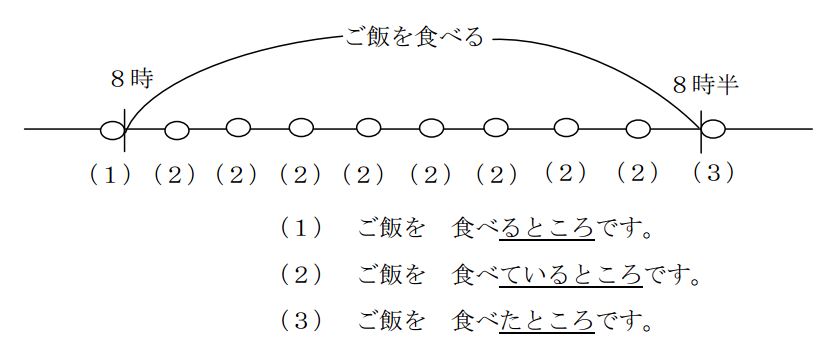
2. The grammar pattern ばかり
Structure: V た ばかりです (saying that an action has just happened)
Meaning:: to have just (done ~)
Usage: Used to describe an action that has only just been completed, not long ago. How recent it is is entirely the speaker’s subjective judgement (it may be very recent or in fact quite a while ago)
Examples:
山田さんと山本さんは 3か月まえに 結婚したばかりです。
Ms Yamada and Mr Yamamoto got married just 3 months ago.
田中さんは 3週間まえに ベトナムへ 来たばかりです。
Mr Tanaka came to Vietnam just 3 weeks ago.
このカメラは きのう 買ったばかりです。
I bought this camera only yesterday
Extension:
Expressing cause and effect with 「~ばかりですから、~」 、 「~ばかりなので、~」
さっき 食べたばかりですから、まだ おなかが いっぱいです。
Because I have just eaten, I am still full.
ペンキを 塗ったばかりなので、触らないようにしてください。
It has just been painted, so do not touch it
Expressing a contrary or unexpected result with 「~ばかりですなのに、~」
この時計は 買ったばかりなのに、 もう壊れてしまいました。
I only just bought this watch and yet it is already broken.
きのう 教えたばかりなのに、もう忘れてしまいましたか。
I only taught you yesterday and yet you have forgotten already?
Reference: the difference between the two
「V たところ」 & 「V たばかり」
| 「V たところ」 | 「V たばかり」 |
| It only stresses the moment right after the action is finished; it does not include the speaker’s feelings. |
It describes an action that has just happened but also includes the speaker’s feeling (that it happened only a short time ago) |
| Not used with past time adverbs other than 「たった今」 |
Can be used with past time adverbs such as「この間」「きょねん」… |
| Used to answer, explain or give a reason in response to someone’s question or opening remark. Not used to start a conversation. |
Can be used to start a conversation. |
| E.g.: 飛行機は もう 着きましたか。 …ええ、たった今 着いたところです。 (the plane arrived at 8:30, it is now 8:40) |
E.g.: 私は 3ヶ月前に 結婚したばかりです。 |
->V たばかり is also treated as a noun