Learn Minna no Nihongo Grammar – Lesson 40
Translated from the Vietnamese original. View the original.
Learn Minna no Nihongo Grammar – Lesson 40
Let’s study N5-level Japanese grammar, lesson by lesson, following the Minna no Nihongo textbook.
1. The question particle ~か
1.1 The particle ~か, which we have learned, is usually placed at the end of a question:
A : 会議は 何時に 終わりますか。 What time does the meeting finish?
B : 分かりません。 I do not know.
This lesson covers:
(1) A+B = 会議は 何時に 終わりますか + 分かりません。
What time does the meeting finish? + do not know
→ 会議は 何時に 終わるか、分かりません。
I do not know what time the meeting finishes.
(2) どうしたら いいですか + 考えてください。
What would be the best thing to do? + please think
→ どうしたら いいか、考えてください。
Please think about what would be the best thing to do.
(3) 神戸は どんな町ですか + しりません。
What kind of city is Kobe ? + do not know
→ 神戸は どんな町か、しりません。
I do not know what kind of city Kobe is.
The examples above are questions with a question word used as part of a larger sentence.
1.2 Usage:
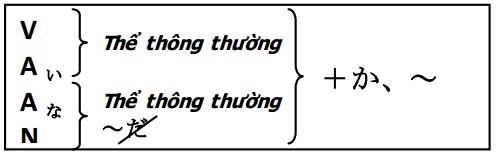
1.3 Note the difference between なにか in examples (1), (1’) and どこか in examples (2),(2’) below:
(1) はこの中身は なにか、調べてください。
Please check what is in the box.
(1’) のどがかわきましたから、 なにか 飲みたいですね。
I am thirsty, so I would really like something to drink
(2) おてあらいは どこか、 わかりません。
I do not know where the toilet is.
(2’) 今日は いい天気ですね。 どこか 行きますか。
The weather is lovely today. Are you going anywhere?
2. The grammar pattern かどうか
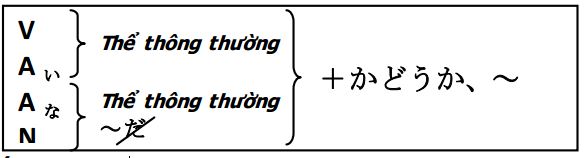
* Meaning: ~かどうか is used when the embedded question has no question word in it.
* Usage: As with ~か、~、 the clause before かどうか
Examples:
(1) リーさんは 来ますか + 分かりません。
Is Mr Lee coming? + do not know
→ リーさんは 来るかどうか、分かりません。
I do not know whether Mr Lee is coming.
(2) まちがいが ありませんか + しらべてください。
Are there any mistakes? + please check
→ まちがいが ないかどうか、しらべてください。
Please check whether there are any mistakes.
A かどうか means “whether it is A or not A”. Example (1) means “Mr Lee may come and may not”
* Note: In example 2, people do not say “まちがいが あるかどうか” but “ まちがいが ないかどうか” because the speaker hopes there are no mistakes.
3. The grammar pattern V て みます。
V て みます。 (trying something out)
Meaning: A pattern expressing that someone wants to try doing something to see how it turns out.
Usage: In this pattern the verb before みます is in the て form. Since みます is originally a verb, it conjugates like other verbs.
Examples:
日本の お酒を飲んでみたいです。
I want to try Japanese sake
ちょっとこの店に 入ってみよう。
Let us try going into this restaurant.
このズボンに 入ってみても いいですか。
May I try these trousers on?
4. Turning adjectives into nouns in Japanese
A い -> A さ
You can turn an い-adjective into an abstract noun describing a quality or state by changing い to さ.
Examples:
高い (high) -> 高さ (height)
* Note especially いい(good) -> よさ(goodness)
新しい (new) -> 新しさ (newness)
山の高さは どうやって はかるか、知っていますか。
Do you know how to measure the height of a mountain?