Learn Minna no Nihongo Grammar – Lesson 39
Translated from the Vietnamese original. View the original.
Learn Minna no Nihongo Grammar – Lesson 39
Let’s study N5-level Japanese grammar, lesson by lesson, following the Minna no Nihongo textbook.
1. Grammar
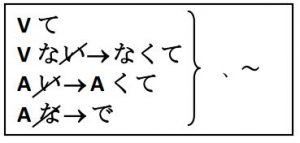
The forms above are used to give a cause or reason. In this pattern the first clause gives the cause and the second gives the result it produces.
Unlike ~から, which we learned in lesson 9, this pattern has a number of restrictions.
Usage:
1.1 The second clause usually contains words that carry no intention, specifically:
◈ Adjectives and verbs expressing emotion: びっくりする、安心する、困る、さびしい、残念だ…
ニュースを聞いて、 びっくりしました。
I was surprised when I heard the news.
暑くて、寝られませんでした。
I cannot sleep because it is hot.
◈ わからない and negative potential verbs: いけない、のめない、食べられない…
土曜日は 都合が悪くて、いけません。
I cannot go because I am busy on Saturday.
話が複雑で、あまりわかりませんでした。
I do not really understand because the story is complicated.
◈ A situation in the past:
じこがあって、バスが 遅れてしまいました。
The bus was late because of an accident.
授業に遅れて、先生にしかられました。
I was told off by the teacher because I was late for class.
1.2 In this pattern, the second clause cannot express intention (will, an order, an invitation, a request). When the second clause carries intention, the first clause does not use the て form; から is used instead.
あぶないですから、きかいに触らないで ください。 ( ○ )
It is dangerous, so please do not touch the machine.
あぶなくて、きかいに 触らないで ください。 ( × )
1.3 In this pattern, the first and second clauses are in time order. That is, what happens in the first clause comes first and what happens in the second clause comes after:
あした 会議が ありますから、今日 準備しなければ なりません。(○)
There is a meeting tomorrow, so I have to prepare today.
あした 会議が あって、今日 準備しなければなりません。(×)
2. The grammar pattern N で
2.1 The particle で often gives a cause; in that case the noun used is usually one strong enough to cause a result, such as: じこ(accident), じしん (earthquake), かじ (fire)…
Examples:
じこで 電車が とまりました。
The accident stopped the trains.
ゆきで 新幹線が 遅れました。
Snow made the Shinkansen late.
2.2. It is not used when the second clause carries intention:
病気で 明日 会社を 休みたいです。 ( × )
I am ill, so I want to take tomorrow off.
3. The grammar pattern ~ので
3.1 Meaning:
– Like ~ から, which we learned in lesson 9, ~ので gives a cause or reason. ~から stresses the cause subjectively, while ~ので presents the link between cause and effect objectively, as a natural sequence.
– ~ので is used to soften the speaker’s subjectivity so the listener does not feel pressured; it is also often used to give a reason gently when asking permission.
気分が悪いので、先に 帰っても いいですか。
I am not feeling well, so may I leave early?
バスが なかなか 来なかったので、大学に遅れました。
The bus just would not come, so I was late for class.
– Because it is a gentle, objective expression, the imperative and prohibitive forms are not used in the second clause.
この荷物は じゃまなので、かたづけろう。 (×)
This luggage is in the way, so let us move it.
3.2 Usage: ~ので comes directly after a noun, verb or adjective in the plain form
| V | plain form | +ので、~ |
| A い | ||
| A な | plain form ~だ-> な |
|
| N |
3.3 ~ので follows the plain form as shown above; when you want to be more polite, put it after the polite form:
Examples:
レポートを 書かなければなりませんので、今日は はやく 帰ります。
(=レポートを 書かなければならないので、今日は はやく 帰ります。)
I have to write a report, so I am going home early today
4. The difference between 気持ちがいい and 気分がいい
These expressions have different meanings, so be careful how you use them.
| 気持ちがいい is used when the speaker feels pleasant or refreshed because of something external. Examples: 今日は天気がよくて、気持ちがいいです。 The weather is lovely today, which makes me feel refreshed. |
気分がいい is used when the speaker feels pleasant or well from within, such as psychologically or physically. Examples: 薬を飲んで、熱が下がったので、気分が いいです。 I took the medicine, my fever went down and I feel well. |