The 48 Most Basic Japanese Kanji Radicals
31/05/2021Updated 07/04/20262 min read
Translated from the Vietnamese original. View the original.
The 48 most basic Japanese kanji radicals
The 48 most basic Japanese radicals, to make learning kanji easier for you.
The 48 most basic kanji radicals appear in 75% of Japanese KANJI. Remember these 48 and you can confidently work out the meaning of kanji. These 48 basic radicals are the first thing every learner of Japanese has to know well.
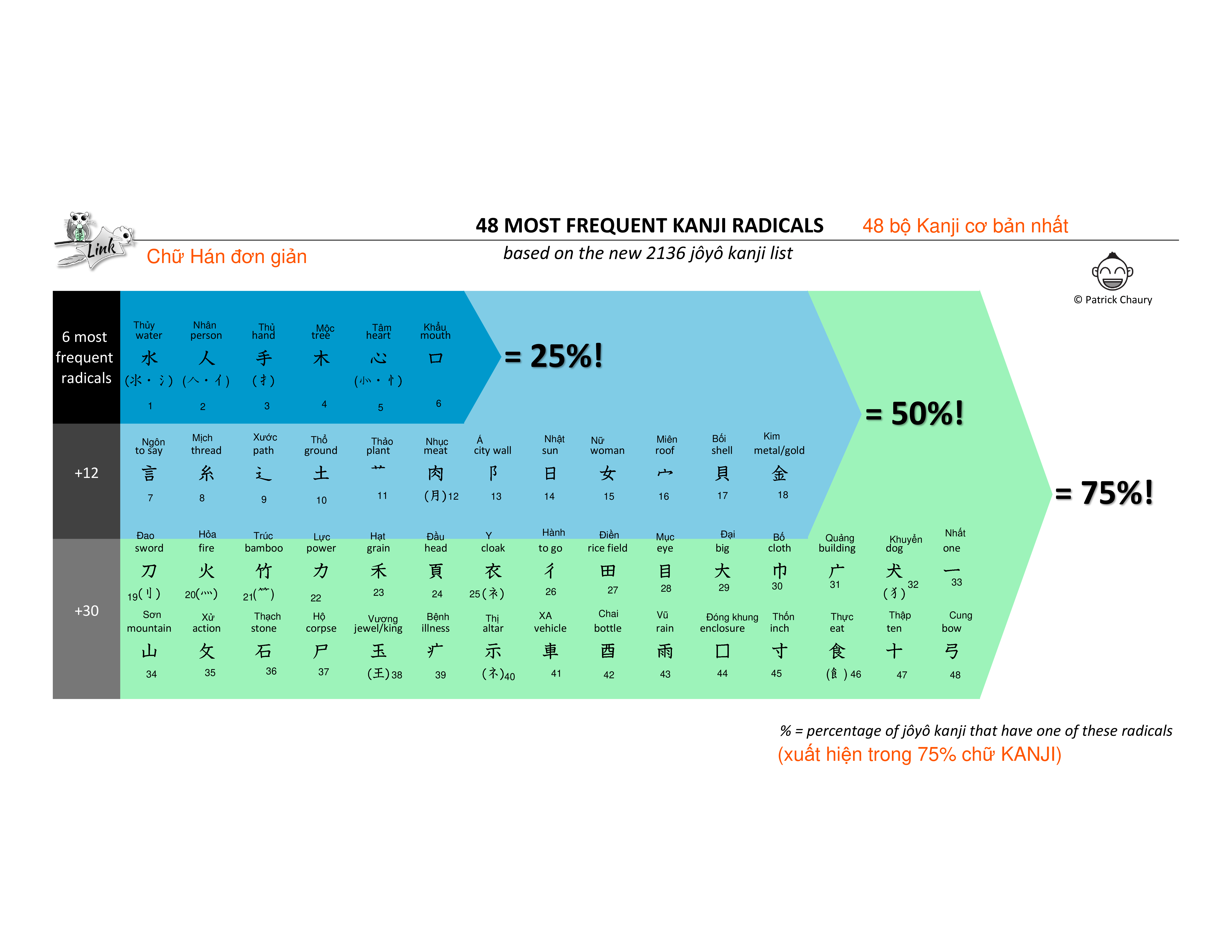
The 48 most basic Japanese radicals are for those getting to know the kanji. We hope this helps you remember and learn kanji as effectively as possible.
| STT | Kanji | Sino-Vietnamese name | Meaning |
| 1 | 人 | Nhân | Person, with two legs, a creature that stands upright; also written as the standing form 仁. |
| 2 | 口 | Khẩu | Mouth (the shape of a mouth). |
| 3 | 心 | Tâm | Heart. Also written: 忄 or the character for small with an added stroke on the right (小丶). |
| 4 | 手 | Thủ | Hand. Also written: 扌, 才. |
| 5 | 木 | Mộc | Tree, wood (the shape of a tree with branches and roots). |
| 6 | 水 | Thủy | Water (the shape of flowing water). Also written: 氵. |
| 7 | 糸 | Mịch | A fine silk thread. |
| 8 | 言 | Ngôn | Speech (conversation). |
| 9 | 辶 | Xước | To go and stop again. |
| 10 | 土 | Thổ | Earth (the two-stroke 二 with the vertical 丨, like a plant growing out of the ground) |
| 11 | 艹 | Thảo | Grass. Also written: 丱, 艸. |
| 12 | 肉 | Nhục | Meat |
| 13 | 女 | Nữ | Woman |
| 14 | 宀 | Miên | Roof |
| 15 | 貝 | Bối | Shell (in the past shells were used as money) |
| 16 | 金 | Kim | Metal, gold |
| 17 | 邑 (阝) | Ấp | A territory, land granted to an official |
| 18 | 日 | Nhật | Day, sun |
| 19 | 刀 | Đao | Con dao |
| 20 | 火 | Hỏa | Fire |
| 21 | 竹 | Trúc | Bamboo |
| 22 | 力 | Lựa | Strength |
| 23 | 衤 | Y | Clothing |
| 24 | 亠 | Head | No meaning of its own; usually the top part of other characters. |
| 25 | 田 | Điền | Field |
| 26 | 目 | Mục | Eye |
| 27 | 犬 | Khuyển | Dog |
| 28 | 大 | Đại | Big |
| 29 | 山 | Sơn | Mountain |
| 30 | 戶 | Hộ | A single-leaf door. |
| 31 | 一 | Nhất | One, the first of the numbers. |
| 32 | 丨 | Cổn | A vertical stroke running from top to bottom. |
| 33 | 丶 | Chủ | A dot, a single point. |
| 34 | 丿 | Phiệt | The left-falling stroke of a Chinese character, running from right to left. |
| 35 | 亅 | Quyết | A vertical stroke with a hook. |
| 36 | 勹 | Bao | To wrap, to bend over and hold something. |
| 37 | 匕 | Chủy | A spoon. |
| 38 | 厶 | Tư | Private |
| 39 | 囗 | Vi | To surround (an enclosing boundary). |
| 40 | 夕 | Tịch | Night, darkness |
| 41 | 子 | Tử | Con |
| 42 | 幺 | To love | Small, dainty |
| 43 | 欠 | Khiếm | Lacking, impolite |
| 44 | 禾 | Hòa | Rice plant |
| 45 | 老 | Nhĩ | Ear, for hearing |
| 46 | 走 | Tẩu | To run |
| 47 | 雨 | Vũ | Rain |
| 48 | 米 | Mễ | Rice |
See also:
Learning the 1945 Japanese Kanji and Their Sino-Vietnamese Readings
N5 Kanji