N3 Grammar: The Difference Between ほど, くらい and ころ
Translated from the Vietnamese original. View the original.
N3 grammar: the difference between ほど, くらい and ころ
These words all indicate degree, like “about, around”, but different structures are used depending on the context.
All three words ほど、くらい and ころ can follow a noun of time. In meaning, all three mean “about / around” and express degree:
ほど [Hodo]: about, as much as, to the extent that
くらい/ぐらい [kurai]: about, around, roughly, to the degree
ころ[ Koro]: around, about (a time). Goes with a specific point or period in time.
But their usage in Japanese grammar differs as follows:
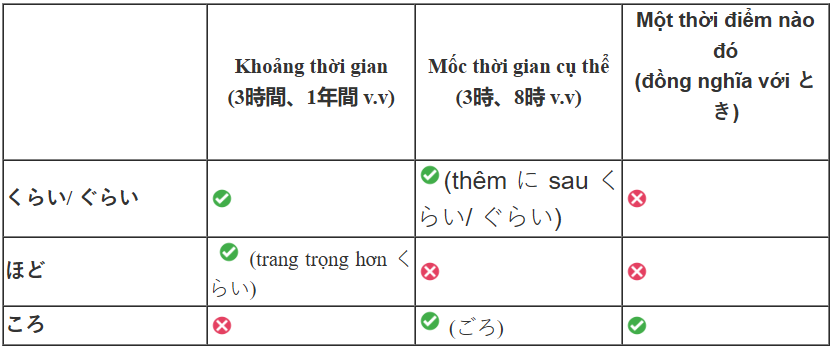
A. ほど、くらい/ぐらい
ほど: about, as much as, to the extent that
くらい, ぐらい: about, around, roughly, to the degree
I. Cases where both ほど and くらい/ぐらい can be used
Case 1: ほど and くらい/ぐらい after a number: words indicating quantity
1. 今までに二年間くらい/ぐらい/ほど 日本語を勉強しています。
So far I have studied Japanese for about 2 years.
2. 健康のために毎日2時くらい/ぐらい/ほど散歩するようにしています。
For my health I try to walk about 2 hours every day.
Case 2: ほど and くらい/ぐらい indicating degree
1. 泣きたいくらい/ぐらい/ほど、お腹が痛いです。
My stomach hurts so much I want to cry
2. 持たれないくらい/ぐらい/ほどの荷物があったので、タクシーで帰りました。
I had so much luggage I couldn't carry it, so I took a taxi home.
II. Cases where only くらい/ぐらい is used
くらい/ぐらい: expresses a minimum degree
忙しくても電話がかけるくらい/ぐらいはできたでしょう。
No matter how busy you are, you should at least be able to make a phone call
そんなことくらいでこどもでもわかります。
Even children can understand this.
III. Cases where only ほど is used
1. ば~ほど: the more ~ the more
女の子は太ければ太いほどきれいになります。
The plumper a girl is, the prettier she becomes.
機会は操作が簡単なら簡単なほどいいです。
The simpler a machine is to operate, the better.
2. ほど~ない: nothing is as… as
今日は思ったほど寒くない。
Today is not as cold as I thought.
ベトナムほどきれいな国はない。
No country is as beautiful as Vietnam.
注意:ほど is more formal than くらい.
B. ころ
ころ: around, about (a time). Goes with a specific point or period in time.
I. Cases where both ころ/くらい can be used
今朝は8時ごろ/くらいに起きました。
This morning I woke up around 8.
II. Cases where only ごろ/ころ can be used
1. 私は中学校のころはよく母にしかられました。
When I was in junior high school I was often scolded by my mother.
2. 気落ちの時は子供のころに戻りたいです。
When I'm down I want to go back to when I was a child.
See also:
The Meaning and Use of わけ in N3
The Meaning and Use of ばかり in N3